
IPA Endorses the GRACE Act to Protect Religious Freedom and Educational Access
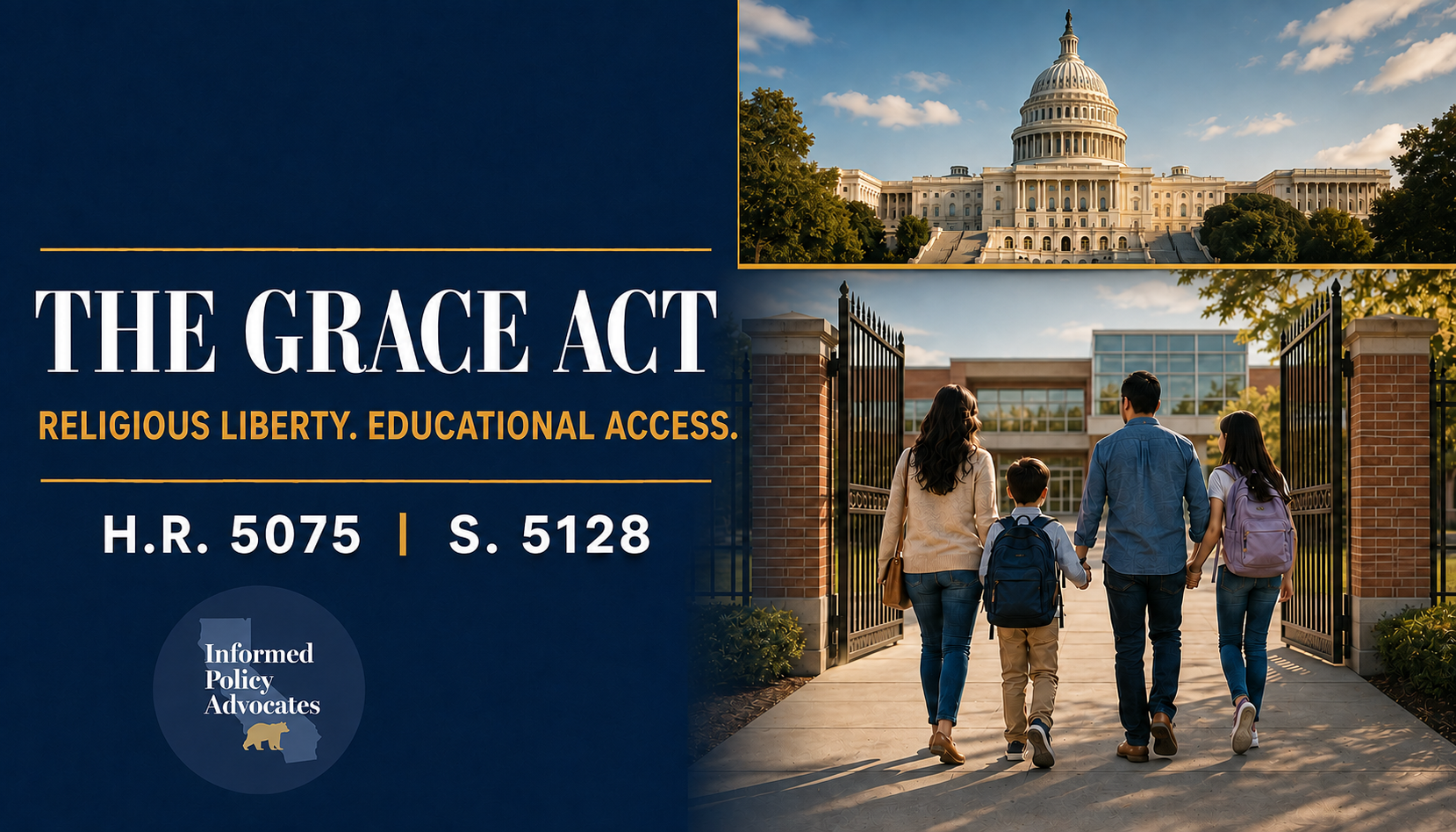
Proposed federal legislation would tie education funding to religious accommodations for school vaccination requirements.
Informed Policy Advocates endorses the Guaranteeing Religious Accommodation in Childhood Education Act, known as the GRACE Act, legislation intended to protect religious freedom and access to education.
Representative Greg Steube of Florida introduced H.R. 5075 in the House of Representatives on August 29, 2025. Senator Mike Lee of Utah introduced the Senate companion bill, S. 5128, on July 23, 2026, with Senator Tommy Tuberville of Alabama as a cosponsor.
Companion bills are matching or substantially similar proposals introduced in both chambers of Congress. Both chambers must approve the same legislative text before it can be sent to the President to become law.
What the GRACE Act Would Change
The GRACE Act would prohibit federal education funds from being provided to covered elementary schools, secondary schools, local educational agencies, or state educational agencies that impose vaccination requirements without maintaining a religious exemption policy.
Under the legislation:
An individual, or a parent or guardian acting for a child, could assert that receiving a required vaccination would violate a sincerely held religious belief.
The institution or agency could not require documentation or other information supporting the validity of that assertion.
The protection would apply to vaccination requirements for enrollment, attendance, athletics, other student activities, and employment within covered institutions and agencies.
The bill would not eliminate vaccination requirements. It would establish a condition on federal education funding: institutions imposing those requirements must also recognize religious accommodations.
Executive Action and Legislative Protection
The GRACE Act also connects to the broader federal discussion following President Trump’s August 10 executive order on childhood vaccine recommendations. The order directs federal agencies to address compliance with existing constitutional and federal statutory protections involving parental authority, religious freedom, disability accommodations, and equal protection, including exemption obligations where applicable under federal law.
The distinction matters. The executive order directs action under existing legal authority. The GRACE Act would establish a specific funding condition in federal statute. The legislation was introduced before the order and stands on its own.
Neither the executive order nor the introduction of the GRACE Act automatically restores California’s religious exemption. Families should not assume that current school requirements have changed.
For more context, read IPA’s explanation of the executive order and what it means for California.
California’s Experience Shows Why the Bill Matters
California’s 2015 enactment of SB 277 eliminated the personal belief exemption from school vaccination requirements. That exemption included religious objections, so its removal also closed the religious exemption pathway.
For some families, the consequences extend far beyond paperwork. Maintaining their religious convictions can mean losing access to their neighborhood school, taking on homeschooling responsibilities, changing employment, or considering relocation.
Children can lose familiar teachers, classmates, and opportunities to participate in their communities. These educational and financial consequences deserve consideration when lawmakers evaluate exemption policies.
The Principles Behind IPA’s Endorsement
IPA advocates for informed consent, medical consumer protections, and civil rights. Our support for the GRACE Act reflects those priorities.
Public education serves families with different beliefs and circumstances. IPA believes that respecting sincerely held religious convictions should be part of that responsibility, not a reason to deny a child access to education.
The legislation offers a straightforward approach: connect federal education funding to a clear accommodation requirement. Schools could maintain vaccination policies, but covered institutions receiving federal education funds would also have to recognize religious exemptions.
Supporting this principle does not require agreement on every aspect of vaccination policy. It requires taking religious liberty and educational access seriously.
Continuing the Work in California
IPA is pursuing these concerns at the state level through legislative advocacy for physician discretion, medical privacy, informed consent, and fair access to education.
We have also requested a California Senate informational hearing to examine the school medical exemption system following the implementation of SB 276 and SB 714.
Lawmakers should hear from physicians, public health officials, educators, researchers, and affected families. They should examine whether medical exemptions are functioning as intended, whether children with complex medical circumstances are being appropriately accommodated, and what the available evidence shows.
Religious exemptions and medical exemptions serve different purposes. The GRACE Act would not resolve every concern with California’s medical exemption system. That is why federal advocacy and continued work in Sacramento both matter.
A Partnership Grounded in Religious Liberty
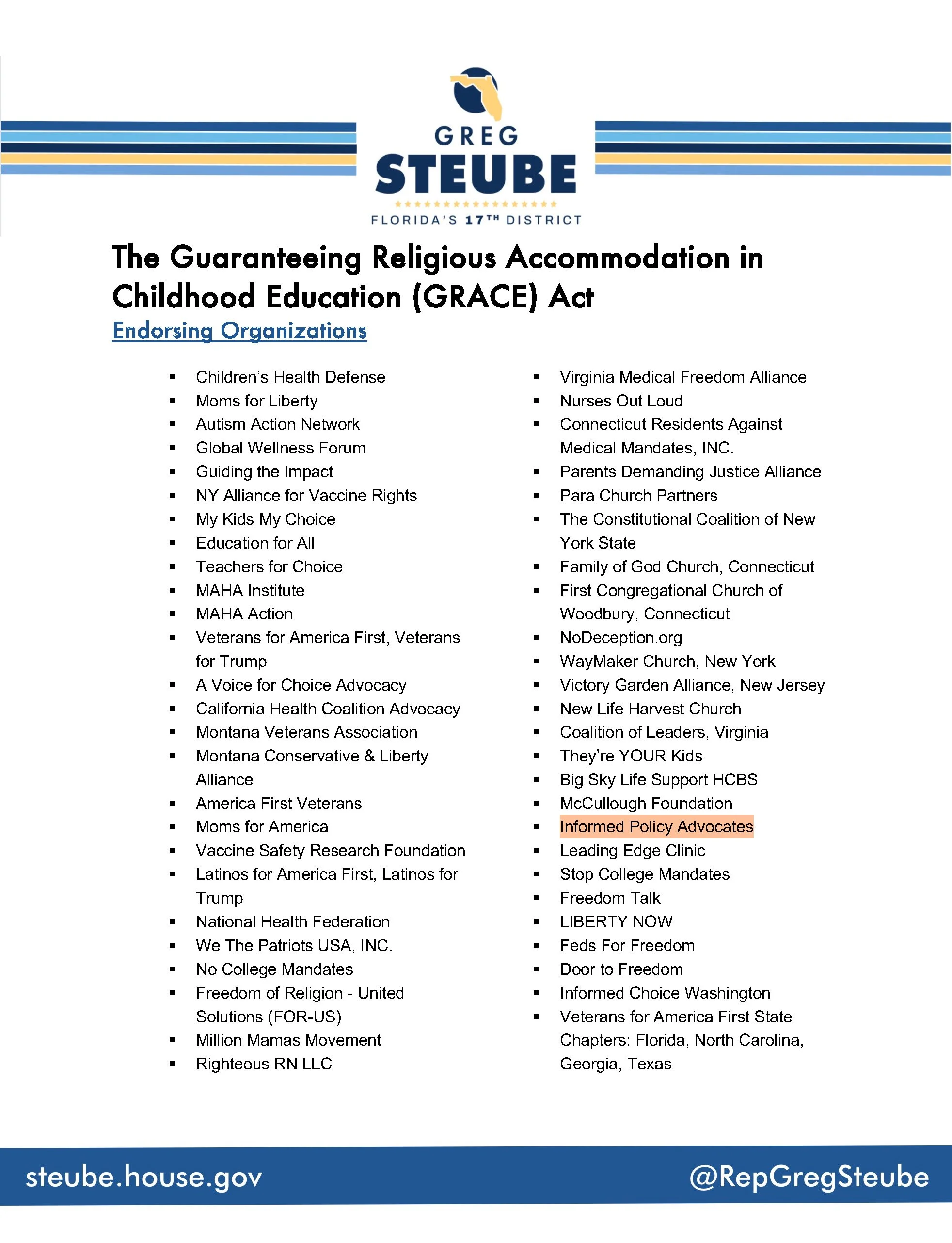
IPA collaborates with Freedom of Religion–United Solutions, known as FOR-US, which brings together people from diverse faith traditions to advocate for religious freedom and informed consent.
Religious liberty does not belong to one political party or denomination. Protecting it means respecting sincerely held beliefs even when others do not share them.
Protecting Families Across State Lines
IPA supports the GRACE Act because families deserve a consistent standard for religious accommodation in federally funded education.
We encourage Congress to give H.R. 5075 and S. 5128 full and fair consideration while IPA continues advocating for accountability, informed consent, and civil rights in California.
Learn more at InformedPolicyAdvocates.org or IPAaction.com to participate in our advocacy campaigns.