
HHS Wants Public Input on Federal Vaccine Recommendations
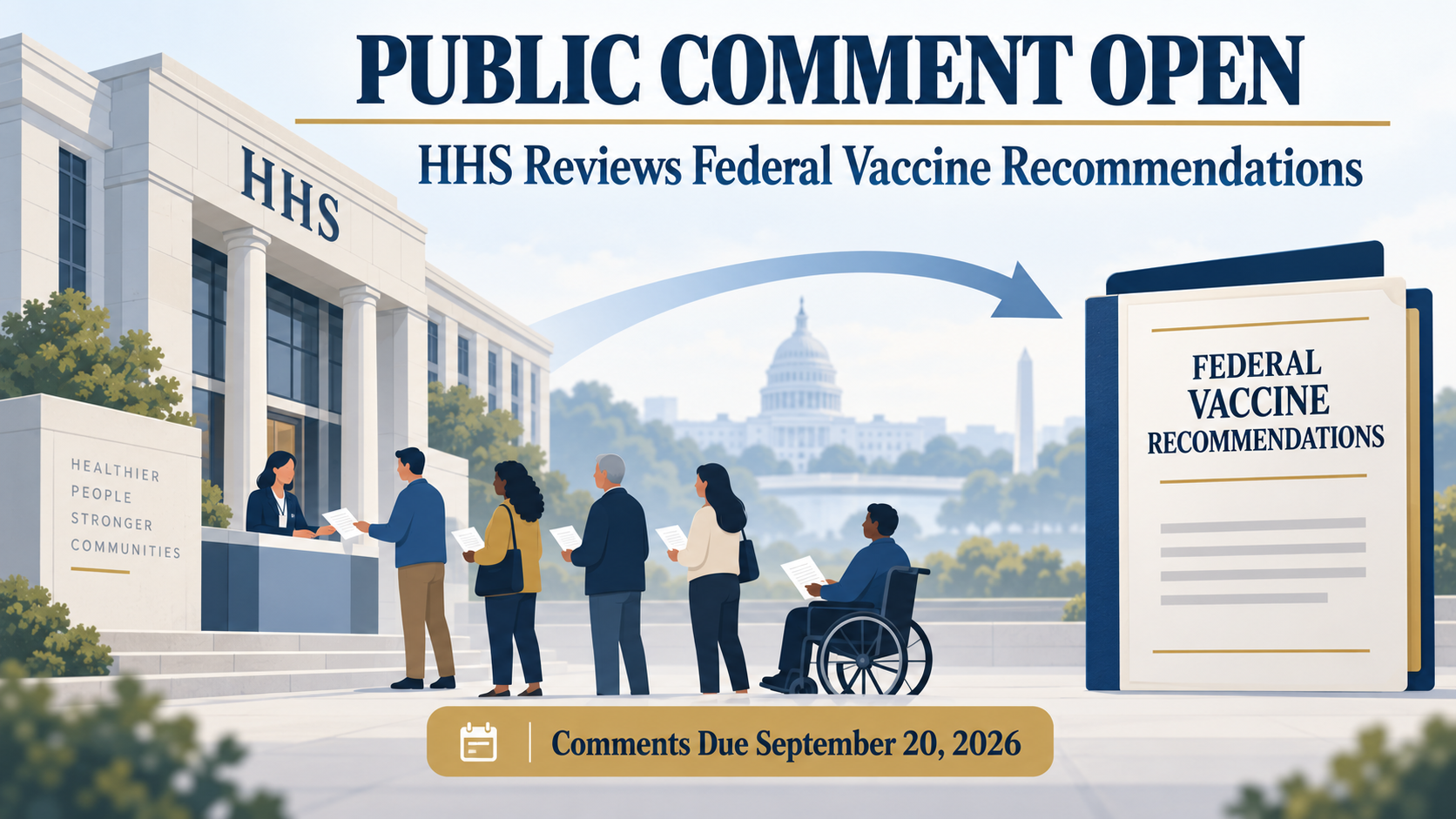
Comments are due September 20, 2026
The U.S. Department of Health and Human Services is reviewing how federal vaccine recommendations are created, categorized, and explained to the public.
On August 24, 2026, HHS published a formal Request for Information on federal vaccine recommendation categories.
The review follows the August 10, 2026, Executive Order, “Delivering Gold Standard Childhood Vaccine Recommendations for Americans,” and will support the work of the Task Force on Safer Childhood Vaccines.
The public has until September 20, 2026, to submit comments.
What Is HHS Reviewing?
Federal vaccine recommendations generally fall into three categories:
Routine recommendations for everyone in a certain age group.
Risk based recommendations for people with certain health, occupational, or exposure risks.
Shared clinical decision making recommendations that are supposed to be based on a conversation between the patient or parent and a healthcare provider.
HHS wants to know whether these categories are clear and whether they accurately show the strength of the evidence behind each recommendation.
The Department is also asking whether “shared clinical decision making” should be renamed “individualized assessment” when a vaccine’s expected benefit may be different from one person to another.
Other questions include:
How should HHS explain uncertainty or limited evidence?
Should federal recommendations allow more flexibility in vaccine timing and scheduling?
How should individual benefit be separated from population benefit?
How do mandates and other high pressure policies affect long term public trust?
What information should be collected to determine whether the recommendation system is working?
Federal Recommendations Can Affect State Policies
Federal vaccine recommendations do more than guide conversations in a doctor’s office. They can influence insurance coverage, government vaccine programs, school requirements, medical exemption policies, electronic health records, and access to vaccine injury compensation programs.
That is why the categories and the words used to describe them matter.
A federal recommendation may provide important scientific guidance, but it should not automatically become a mandate. Any compulsory policy should require a separate review of necessity, individual and population benefit, available alternatives, medical exemptions, disability accommodations, privacy protections, and the consequences of excluding someone from school or other essential services.
IPA’s Position
Informed Policy Advocates believes informed consent and meaningful medical discussion should apply to every vaccine recommendation, not only those placed in the shared clinical decision making category.
Patients and parents should have access to understandable information about the expected benefits, known risks, available alternatives, and areas of uncertainty. They should also be able to discuss their individual medical circumstances with a licensed healthcare provider.
When the expected benefit may vary significantly from person to person, IPA supports calling the recommendation a “recommendation based on individualized assessment.”
IPA is also asking HHS to measure more than vaccine uptake. Federal and state agencies should examine adverse event signals, medical exemption access, processing times, appeals, physician participation, privacy concerns, disability impacts, educational exclusion, and public trust over time.
Standard forms may make a system more consistent, but standardized paperwork does not guarantee that each person receives a fair review.
What Should You Include in Your Comment?
You do not need to answer every question in the HHS request. You can focus on the issues that matter most to you.
Begin by briefly explaining who you are and why this issue affects you. If you have personal experience involving informed consent, a vaccine injury, a medical exemption, a religious objection, physician access, school exclusion, or disability accommodations, explain that experience in your own words.
Then identify the changes you want HHS to make. Specific recommendations are more useful than a statement that simply supports or opposes vaccination.
A short comment describing an actual experience and requesting two or three specific changes will generally be more meaningful. For example:
Re: Docket HHS OS 2026 0332
I am the parent of a child with complex medical needs. When I raised concerns about my child’s individual medical history, I found that the system focused more on following a standard schedule than allowing a meaningful discussion with our physician. Our family also faced concerns about whether an individualized medical decision could affect our child’s access to school.
I ask HHS to make three changes:
Require informed consent and meaningful clinical discussion for every vaccine recommendation category.
Create a “recommendation based on individualized assessment” category when the expected benefits and risks may differ from one person to another.
Clearly state that a federal recommendation should not automatically become a mandate without a separate review of necessity, medical exemptions, less restrictive alternatives, and the effects of exclusion from education.
Federal guidance should protect both public health and the right to individualized medical care.
How to Submit a Comment
This HHS request does not change the federal vaccine schedule, California law, school requirements, or existing insurance coverage. It is a request for information, not a new regulation.
It does provide an opportunity for patients, parents, healthcare providers, organizations, and members of the public to place their concerns and recommendations into the federal record.
Comments may be submitted through Regulations.gov through September 20, 2026.
Reference Docket HHS OS 2026 0332 when submitting a comment.
Stay Connected With IPA
Sign up for legislative updates, policy analysis, public comment opportunities, and action alerts at InformedPolicyAdvocates.org.
Visit IPAaction.com to make your voice heard on current policy issues.
Follow us on Instagram @informedpolicyadvocates and X @IPadvocates.