
President Signs Executive Order on Childhood Vaccines: What It Means for California

On August 10, 2026, President Donald Trump signed a new Executive Order establishing what the Administration calls the “Gold Standard Childhood Vaccine Recommendations” and directing federal agencies to take additional action on childhood vaccine policy, parental choice, medical and religious exemptions, disability accommodations, informed consent, and vaccine safety research.
The Executive Order represents a significant shift in federal childhood vaccine policy. But what does it actually mean for California?
What Does the Executive Order Do?
Fact Sheet Here
The order establishes three categories of federal childhood vaccine recommendations:
Recommended for all children:
Measles, mumps, rubella, diphtheria, tetanus, pertussis, polio, Hib, pneumococcal disease, HPV, and varicella.
Recommended for certain high risk groups or populations:
RSV monoclonal antibodies, hepatitis A, hepatitis B, meningococcal B, meningococcal ACWY, and dengue.
Shared clinical decision making:
Hepatitis A, hepatitis B, rotavirus, meningococcal disease, influenza, and COVID 19.
The order also directs HHS to examine vaccine timing and sequencing, single antigen vaccine options beginning with MMR, alternatives to aluminum adjuvants, continuous risk benefit evaluation, and improvements to vaccine safety monitoring, transparency, and research.
Perhaps most significant for states like California, the President specifically advises states to review their existing vaccine laws and school immunization requirements in light of the new federal recommendations.
Does This Change California Law?
Not immediately.
California still controls its own school and childcare vaccine requirements. The Executive Order does not automatically restore religious or personal belief exemptions, repeal SB 276 or SB 714, or change the current CAIR ME system.
But the federal policy landscape has changed substantially.
And California has already created a framework to respond differently to changes in federal guidance.
Where AB 144 Comes In
California has taken steps to maintain greater state control over vaccine recommendations when federal guidance changes.
In 2025, Governor Gavin Newsom signed AB 144, which established a California specific framework for preventive health and immunization recommendations. Among its provisions, AB 144 allows California to maintain and modify recommendations independently of later federal changes. (See our newsblog on AB 144)
In other words, California created a mechanism to chart its own course if federal vaccine policy changed.
That change has now happened.
The new Executive Order moves federal policy in a different direction, emphasizing parental choice, informed consent, individualized medical decision making, additional vaccine safety research, and review of state vaccine requirements.
California may ultimately choose to maintain its current approach.
But that raises an important question:
If California chooses a different path from current federal recommendations, what evidence and review process will be used to support that decision?
California does not have to follow Washington. But California should be able to demonstrate that its own policies reflect the best available evidence and appropriately protect individual medical circumstances, physician judgment, disability accommodations, and informed consent.
Why Section 4 Matters for California
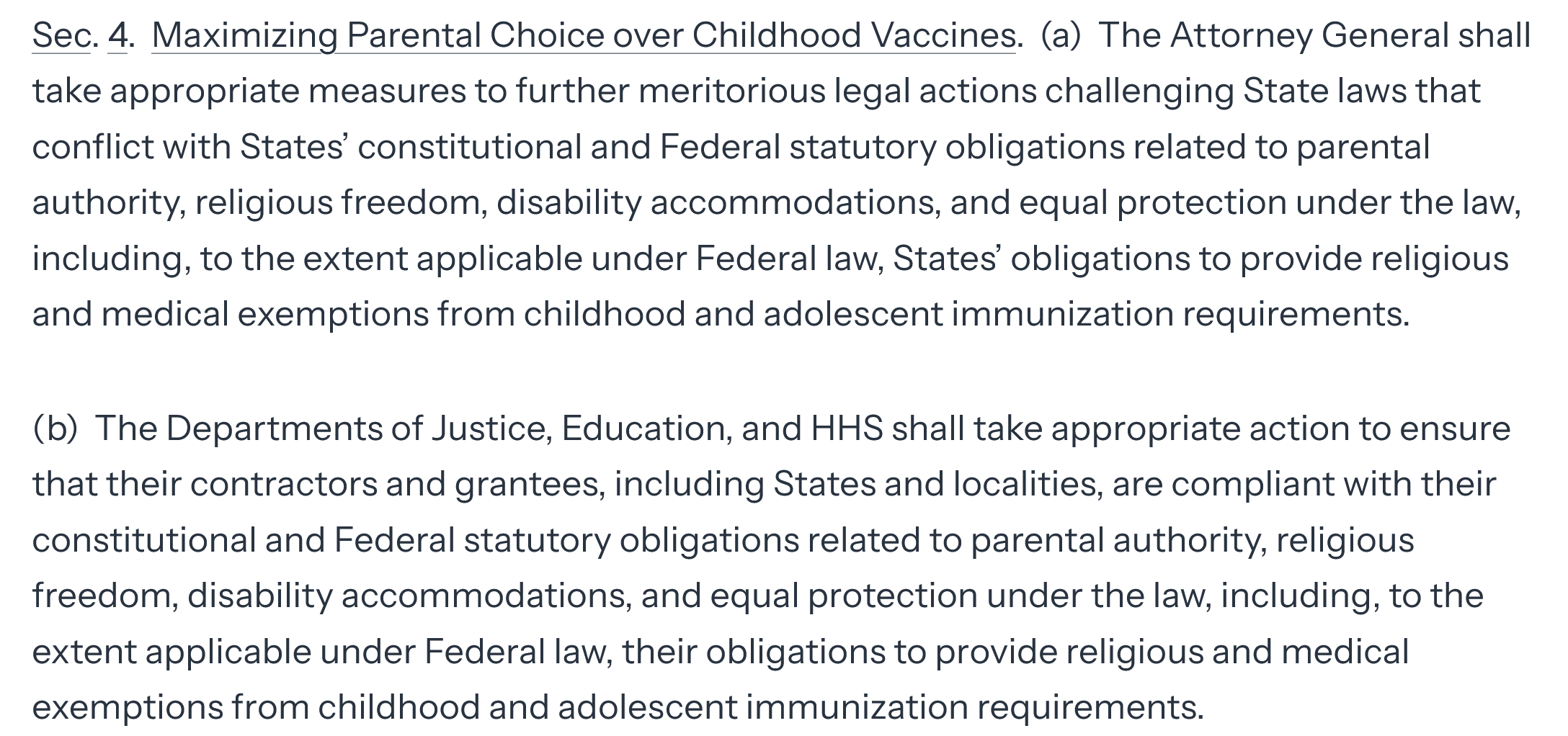
One of the most consequential provisions may be Section 4, titled “Maximizing Parental Choice over Childhood Vaccines.”
The Executive Order directs the U.S. Attorney General to take appropriate measures to further meritorious legal challenges involving state laws that may conflict with constitutional or federal statutory protections related to:
Parental authority
Religious freedom
Disability accommodations
Equal protection
Medical and religious exemptions
The Departments of Justice, Education, and Health and Human Services are also directed to ensure that federal contractors and grantees, including states and local governments, comply with applicable federal protections.
This does not mean the federal government has determined that California’s current laws are unlawful.
It does mean that questions involving medical exemptions, disability accommodations, parental authority, and other federal protections are receiving renewed federal scrutiny.
Why This Strengthens the Case for an Informational Hearing
California’s school vaccine and medical exemption policies have changed significantly over the last decade.
SB 277 eliminated personal belief exemptions in 2015.
SB 276 and SB 714 expanded state oversight of medical exemptions.
AB 144 gave California greater independence from subsequent changes in federal vaccine recommendations.
Now the federal government has materially changed its childhood vaccine policy and is expressly advising states to review their school immunization requirements.
Whatever Californians think about the new federal direction, California lawmakers should be willing to examine the evidence publicly.
An informational hearing does not require legislators to agree with the President. It does not change California law. It simply gives lawmakers an opportunity to ask:
What is working?
What is not?
Are medical exemptions functioning as intended?
Are physicians able to exercise appropriate individualized medical judgment?
Are children with disabilities and complex medical circumstances being appropriately accommodated?
What does California’s own data show?
And what evidence supports California’s current policy choices?
Physicians, researchers, disability experts, public health officials, parents, and affected families should all have a seat at that table.
California can chart its own course. But it should show its work.
With the authority to make independent public health decisions comes a responsibility to demonstrate that those decisions are supported by evidence, transparency, accountability, and meaningful legislative oversight.
What Happens Next?
The Executive Order directs HHS to develop plans within 90 days addressing vaccine timing and sequencing, vaccine safety research, single vaccine options, alternative adjuvants, and improved safety monitoring and transparency.
Those developments could raise additional questions for California policymakers in the months ahead.
IPA will continue monitoring implementation of the Executive Order and what it may mean for California families.
One thing should not require agreement on every aspect of vaccine policy: transparency and accountability matter.
After nearly a decade of major changes to California’s school vaccine and medical exemption policies, it is time to review the data, hear from all stakeholders, and hold an informational hearing.
Take Action Today
If you believe California families deserve transparency, accountability, and a public review of these policies, join IPA’s campaign requesting an informational hearing in the California Legislature.
Visit IPAaction.com and take action today.