
Two Guilty Pleas Raise Questions About Public Health Accountability
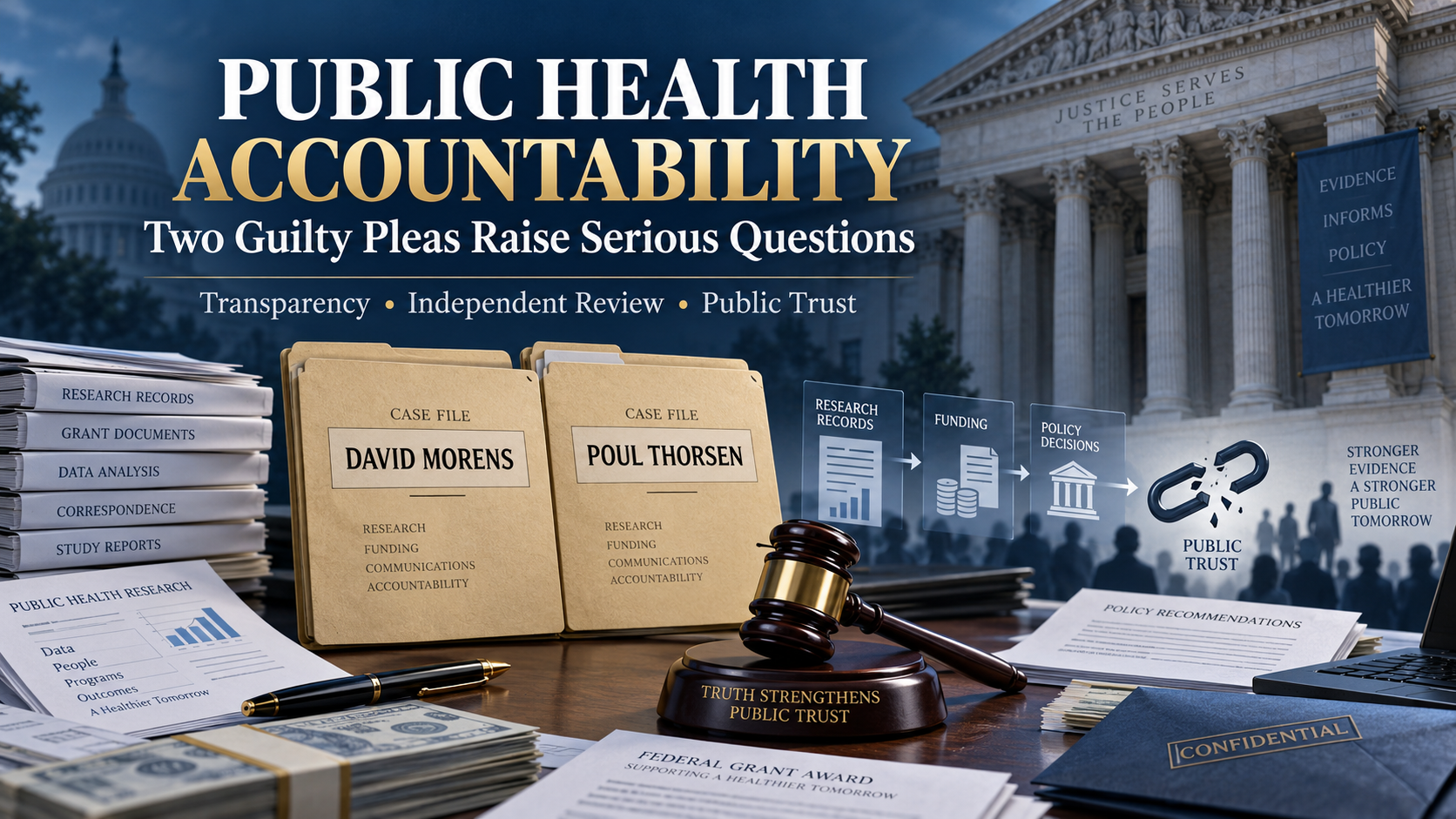
Public trust depends on evidence that can be independently verified
Two recent guilty pleas involving people connected to federally funded public health research raise serious questions about transparency, oversight, and the evidence used to support public policy.
The cases involve different conduct. Neither proves that every vaccine study or public health recommendation is false. Together, however, they show why government agencies, scientists, and medical organizations should not be treated as unquestionable authorities.
When public policy affects informed consent, individual liberty, medical privacy, and access to education or employment, the supporting evidence must be transparent and independently verified.
Former NIAID Official Admits Concealing Records
On August 18, 2026, the Department of Justice announced that former senior NIAID official David Morens pleaded guilty to charges connected to concealing federal records.
According to the U.S. Attorney’s Office for the District of Maryland, Morens admitted using personal email to conduct government business and participating in efforts to avoid federal records and public disclosure requirements.
Public records allow Congress, researchers, journalists, and the public to examine what evidence officials considered and how decisions were made. When those records are concealed, meaningful independent review becomes much harder.
CDC Funded Researcher Pleads Guilty to Wire Fraud
On September 1, 2026, Danish researcher Poul Thorsen pleaded guilty to wire fraud involving CDC grant money.
According to the U.S. Attorney’s Office for the Northern District of Georgia, the CDC awarded more than $11 million to Danish government agencies for research that included examining possible relationships between vaccines and autism.
Thorsen became the principal investigator responsible for administering the funding. Prosecutors reported that he submitted fraudulent invoices containing the forged signature of a CDC laboratory official and diverted more than $1 million into personal accounts.
Thorsen was also a coauthor of widely cited publications examining vaccines and autism. His guilty plea involved stealing research funds. It does not, by itself, prove that he falsified the data or conclusions of those studies.
But his conduct cannot simply be dismissed as irrelevant. When a principal investigator admits stealing money from grants he administered, agencies should examine whether the misconduct affected financial disclosures, research records, data access, or any other part of the research process.
When Questionable Sources Become Coordinated Messaging
When the integrity of an original source becomes questionable, every recommendation and public message built on that source should be reexamined.
This does not automatically make every conclusion false. It does mean those conclusions should no longer be treated as settled without independent review.
Government agencies are not the only institutions shaping public health policy. Medical trade associations, professional organizations, nonprofits, research institutions, and media outlets often repeat agency statements and cite one another as supporting authorities.
This repetition can create the appearance that many independent experts reviewed the evidence and reached the same conclusion. In reality, they may all be relying on the same study, agency statement, or network of connected experts.
Repeating a questionable source does not restore its credibility. It only spreads the same unresolved problem through more organizations and communication channels.
The concern becomes greater when organizations repeating the message receive pharmaceutical funding or have other financial relationships with companies that benefit from the policies being promoted.
These organizations may provide valuable expertise. But the public should know who funded the research and messaging, whether financial conflicts were disclosed, and whether the evidence was independently reviewed.
When coordinated messaging is presented as independent or grassroots support, it is commonly described as astroturfing. It can manufacture the appearance of consensus without proving that the evidence was independently verified.
Public health communication can then begin to function more like product promotion than an honest examination of benefits, risks, uncertainty, alternatives, and individual circumstances.
Repetition is not independent confirmation.
Public Policy Cannot Rely on Authority Alone
Public officials often defend mandates by quoting federal agencies, scientists, medical organizations, or published studies. Those sources may provide important information, but their reputations cannot replace an independent review of the evidence.
Before using a publication or agency recommendation to justify a compulsory policy, policymakers should require:
Independent verification of the evidence.
Disclosure of funding and financial conflicts.
Review of publications and policies affected by proven misconduct.
Consideration of informed consent, individual medical circumstances, religious freedom, medical privacy, and less restrictive alternatives.
A recommendation created for a broad population cannot account for every person’s medical history. It should not erase the role of a licensed physician or an individual’s right to make an informed medical decision.
The Morens and Thorsen guilty pleas do not invalidate every public health publication or recommendation. They do create a clear responsibility to examine the work they influenced and the systems that failed to prevent or expose their conduct sooner.
If affected research remains part of current policy, agencies should explain what independent review was completed and why the evidence is still considered reliable.
Ignoring misconduct or dismissing legitimate questions causes public trust to erode. That loss of trust can spread beyond one official, one study, or one medical product and damage confidence in the entire public health system.
Public health and individual liberty must be considered together. Policies should be supported by reliable evidence, openly debated, regularly reviewed, and no more restrictive than necessary.
Trust is not owed to an institution. It must be earned through transparency, accountability, and respect for the people affected by public policy.
Stay Connected With IPA
Sign up for legislative updates, policy analysis, public comment opportunities, and action alerts at InformedPolicyAdvocates.org.
Visit IPAaction.com to make your voice heard on current policy issues.
Follow us on Instagram @informedpolicyadvocates and X @IPadvocates.