
"Better Messaging" in Public Health Apologia
When I hear public health self-deprecating over their disastrous public health responses I only see "If only we had found a way to spread disinformation better there would be no questions."
Mar 04, 2026
*Article shared with permission
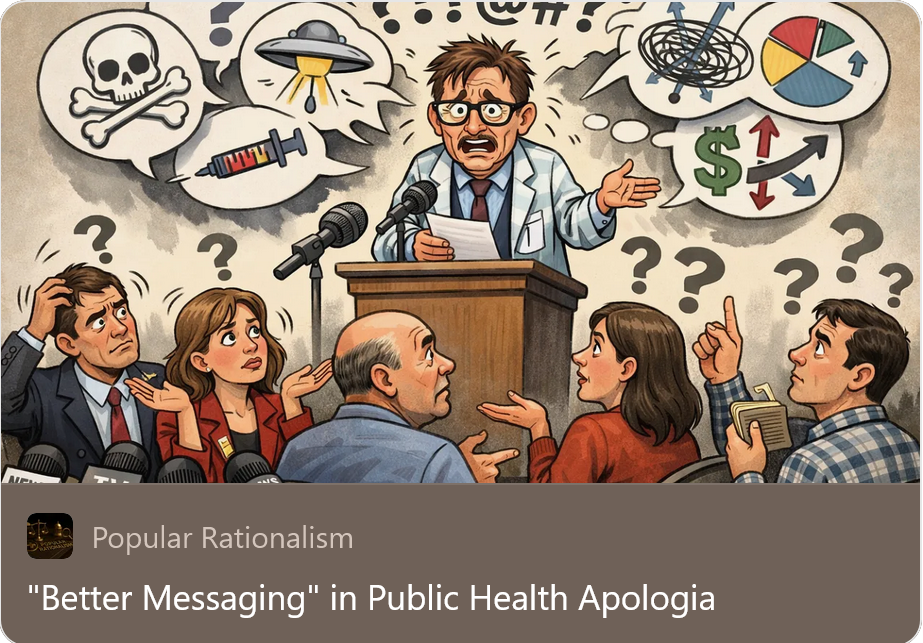
Across nearly every major outbreak and pandemic of the last 50 years, post-crisis reviews have landed on “better communication” as a primary lesson — often as a way of deflecting from deeper structural, scientific, or policy failures. This is a well-documented and recurring pattern in public health history.
Critics like Dr. Harvey Fineberg (1976 postmortem), Peter Sandman (H1N1), and Gursky, Inglesby & O’Toole (anthrax) have consistently argued that “better communication” is sometimes used as a scapegoat to avoid confronting more difficult institutional and scientific failures. The 2003 SARS episode prompted WHO to formalize risk communication as an IHR core function — the most structural response to this pattern — yet as COVID-19 demonstrated, institutionalization did not resolve the underlying problem.
Is this a real thing, or just a placeholder conclusion that stops further questions? Is it a coincidence that those in key positions in public health during major events are really, really bad at communication?
Here are the key historical cases. You decide.
1976 Swine Flu Vaccination Program — Fort Dix, NJ
In 1976, an outbreak of swine flu at Fort Dix, New Jersey caused one death and led to a mass immunization program….